EMPIRE OF DUST
Exposition personnelle à la Galerie RDV, Nantes, dans le cadre de la Quinzaine Photographique Nantaise consacrée au Chaos, du 10 septembre au 10 octobre 2015.
La série photographique Empire of dusta a été réalisée avec le soutien de l'État - Préfet de la Région Pays de la Loire et grâce au soutien de la Région Pays de la Loire et du cabinet Guichen.
Solo exhibition at the Galerie RDV, Nantes, as part of the Quinzaine Photographique Nantaise dedicated to Chaos, from September 10 to October 10, 2015.
The Empire of Dust photographic series was produced with the support of the State - Prefect of the Pays de la Loire Region and thanks to the support of the Pays de la Loire Region and the Guichen studio.


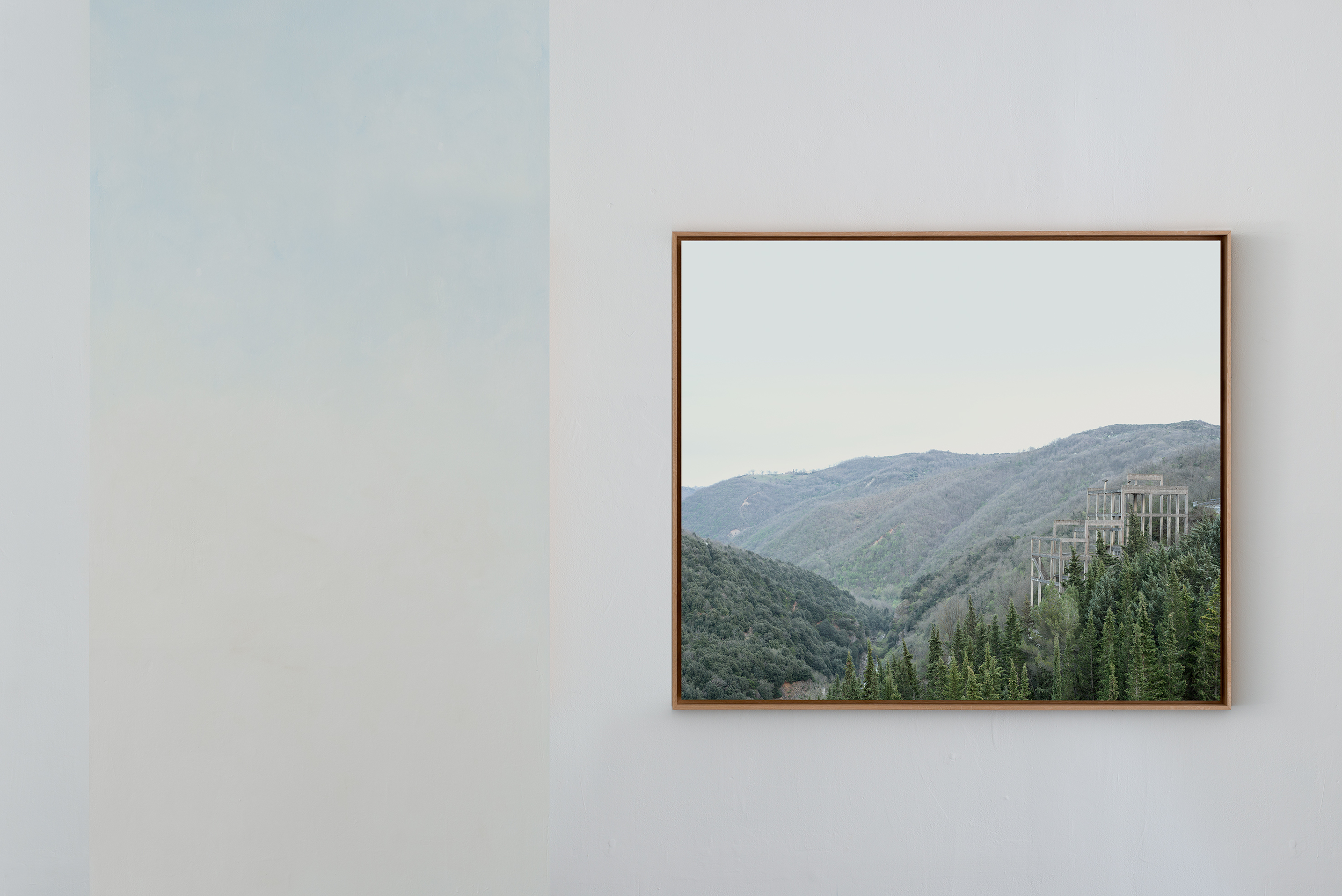
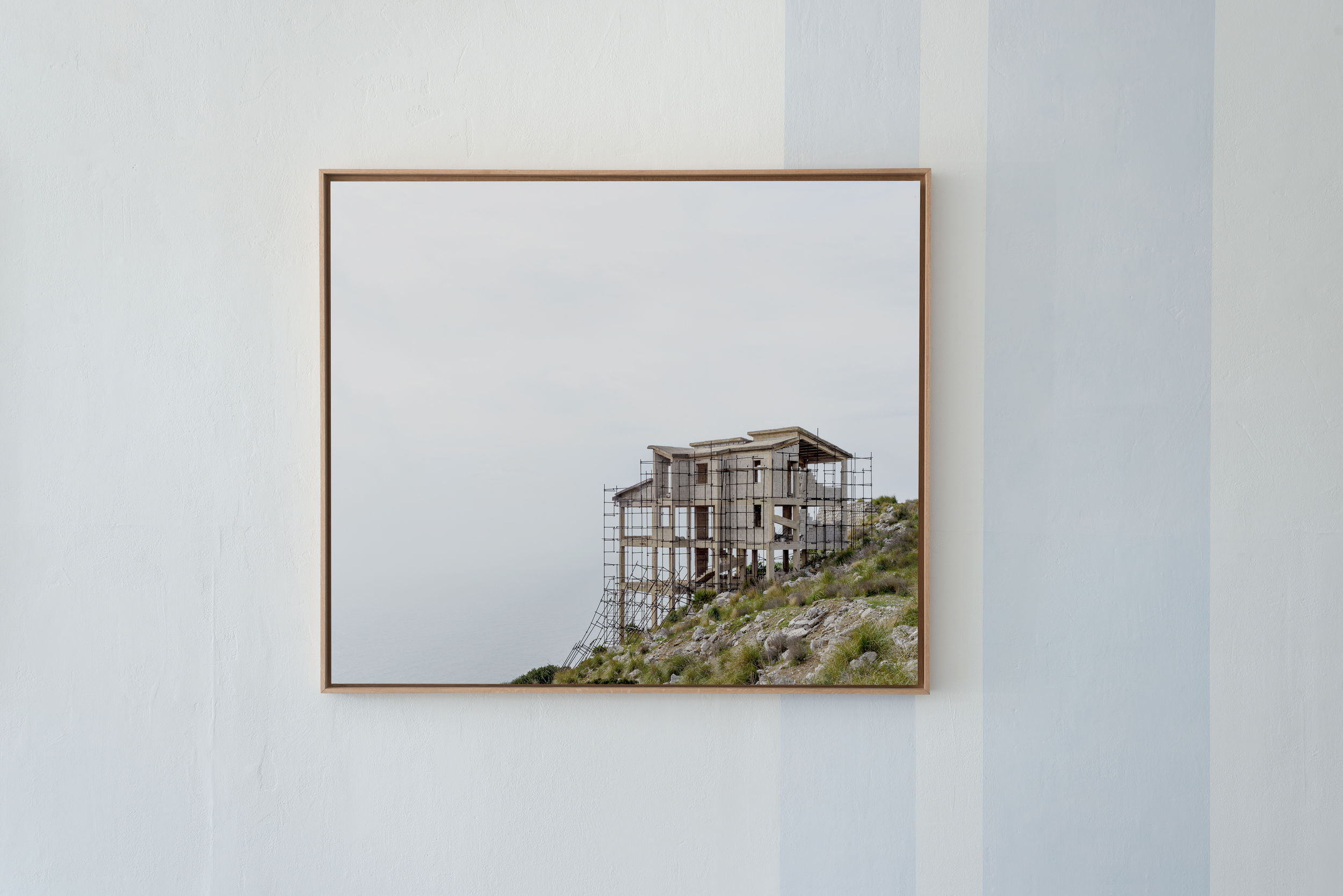


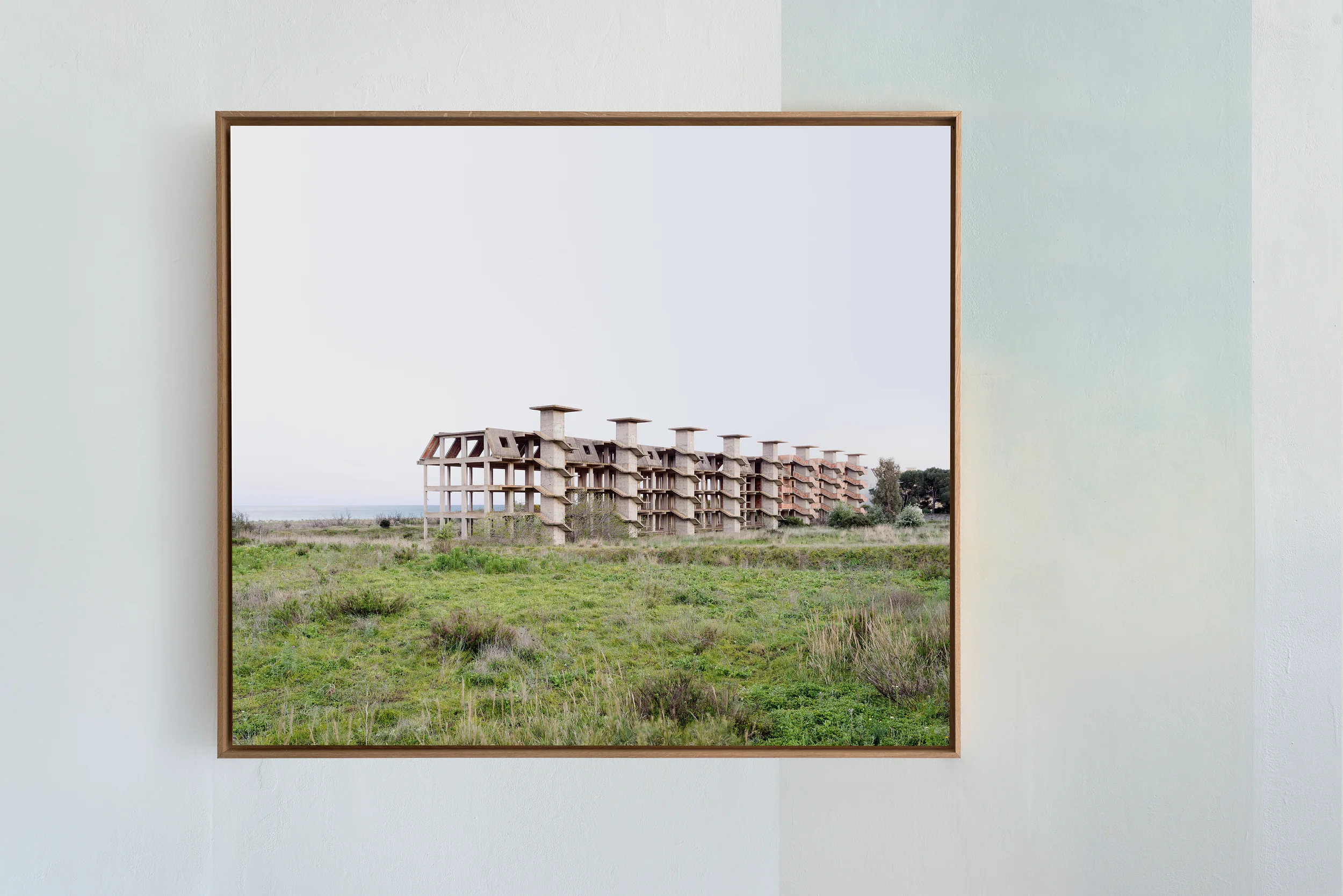


Texte Léa Cotart-Blanco / Communiqué de presse de la Galerie RDV pour l'exposition Empire of Dust (FRANÇAIS)
-- «De manière récurrente, j’interroge, à travers mon travail photographique, ce qui dans le paysage est à priori invisible, un paysage situé en dessous du paysage visible, qui n’est pas donné dans un premier regard. Le paysage nous renvoie à quelque chose de la mémoire collective et individuelle. Il est reflet de l’histoire, d’une époque, ainsi que de notre imaginaire. Je construis et je réalise mes projets photographiques sur la base d’un état de choses existantes et en étroite relation avec l’idée du territoire car c’est du paysage et de cette « archéologie du présent », dont je souhaite parler avant tout.»Amélie Labourdette, août 2015
Empire of Dust est une série de photographies réalisées au sud de l’Italie où les crises et détournements financiers ont fait de l’inachevement une esthétique architecturale. « Il s’agit pour [Amélie Labourdette] de trouver le juste point de conjonction entre une approche de distanciation réflexive et l’expérience de « l’indétermination », de ce qui se dérobe à nous. »
L’esthétique est particulièrement travaillée bien que non maniériste, l’artiste «ne succombe pas à la fascination fétichiste que les bâtiments exercent généralement sur les architectes et les photographes d’architecture. [Elle] cadre [ses] images de manière à ce que les constructions inachevées fassent partie du paysage sans le dominer. Partout, le sol et le vide sont présents, signifiants, à la fois. » L’architecture qui pourrait être le sujet photographique constitue un élément de territoire.
Amélie Labourdette déjoue la temporalité de la prise de vue. L’instant de captation s’étire jusqu’à devenir une période éthérée créant un sentiment d’irréalité ; dans un statisme absolu, la lumière opaque, dense, et l’absence d’ombres réalisent un glissement de la stratification temporelle du paysage qui contient préludes du passé, indices du présent, et stigmates du futur.
Tout élément qui pourrait paraître narratif -comme une figure humaine- est éludé ; toute personnalisation anecdotique est supprimée afin de conserver cette ambiguë universalité. Ces photographies affirment une réalité présente et non immédiate au premier regard, dans un entre-deux au revers de l’évidence et néanmoins manifeste.
-- La pratique d’Amélie Labourdette manie tant le protocole artistique – inspirée par la photographie objective allemande – que la subjectivité plastique – influencée par la peinture romantique-. Le medium photographique sert les regards que l’artiste porte sur le monde, elle déploie les possibilités pratiques de cette technique sans enfermer ses productions dans la performance technologique. Amélie Labourdette interroge les valeurs documentaire, fictionnelle et esthétique induites par ses photographies. Ses créations jouent du trouble entre la réalité du lieu photographié et le réel construit par sa prise de vue. Nous voyons ce qui a été capturé. « Il est étrange de voir comment la réalité n’est pas tout à fait ce qu’elle figure être... »
La série photographique Empire of Dust est réalisée avec le soutien de l’État -Préfet de la région Pays de la Loire et grâce au soutien de la Région des Pays de la Loire et du cabinet Guichen.L’ensemble des citations de l’artiste est issu d’un entretien réalisé par L. Cotart-Blanco disponible en intégralité sur le site de RDV, la dernière citation provient du statement de l’artiste.
Léa Cotart-Blanco
Text by Léa Cotart-Blanco / Press release from Galerie RDV for the exhibition Empire of Dust (ENGLISH)
— “In a recurrent manner, through my photographic work I question what within the landscape is, a priori, invisible, a landscape situated beneath the visible landscape, which is not given at first glance. The landscape refers us to something of both collective and individual memory. It reflects history, an era, as well as our imagination. I construct and realize my photographic projects on the basis of an existing state of affairs and in close relation to the idea of territory, because it is the landscape and this ‘archaeology of the present’ that I seek above all to address.”
Amélie Labourdette, August 2015
Empire of Dust is a photographic series produced in southern Italy, where crises and financial misappropriations have turned incompletion into an architectural aesthetic. “For [Amélie Labourdette], it is a matter of finding the precise point of conjunction between an approach of reflective distanciation and the experience of ‘indeterminacy,’ of that which eludes us.”
The aesthetic is particularly refined yet non-mannerist; the artist “does not succumb to the fetishistic fascination that buildings generally exert on architects and architectural photographers. [She] frames [her] images so that unfinished constructions become part of the landscape without dominating it. Everywhere, ground and void are present, simultaneously signifying.” Architecture, which could be the photographic subject, instead becomes an element of territory.
Amélie Labourdette disrupts the temporality of the photographic capture. The moment of capture stretches until it becomes an ethereal duration, creating a sense of unreality; within an absolute stasis, opaque and dense light, together with the absence of shadows, produces a shift in the temporal stratification of the landscape, containing preludes of the past, indices of the present, and stigmas of the future.
Any element that might appear narrative — such as a human figure — is avoided; any anecdotal personalization is removed in order to preserve this ambiguous universality. These photographs affirm a reality that is present yet not immediately accessible at first glance, existing in an in-between space on the reverse side of evidence and nevertheless manifest.
— Amélie Labourdette’s practice engages both artistic protocol — inspired by German objective photography — and plastic subjectivity — influenced by Romantic painting. The photographic medium serves the perspectives the artist directs toward the world; she deploys the practical possibilities of this technique without confining her productions within technological performance. Amélie Labourdette questions the documentary, fictional, and aesthetic values generated by her photographs. Her creations operate within the disturbance between the reality of the photographed site and the real constructed through the act of capture. We see what has been captured. “It is strange to see how reality is not quite what it appears to be…”
The photographic series Empire of Dust was produced with the support of the French State — Prefect of the Pays de la Loire region — and thanks to the support of the Région des Pays de la Loire and the Guichen firm. All quotations from the artist are drawn from an interview conducted by L. Cotart-Blanco, available in full on the RDV website; the final quotation comes from the artist’s statement.
Léa Cotart-Blanco