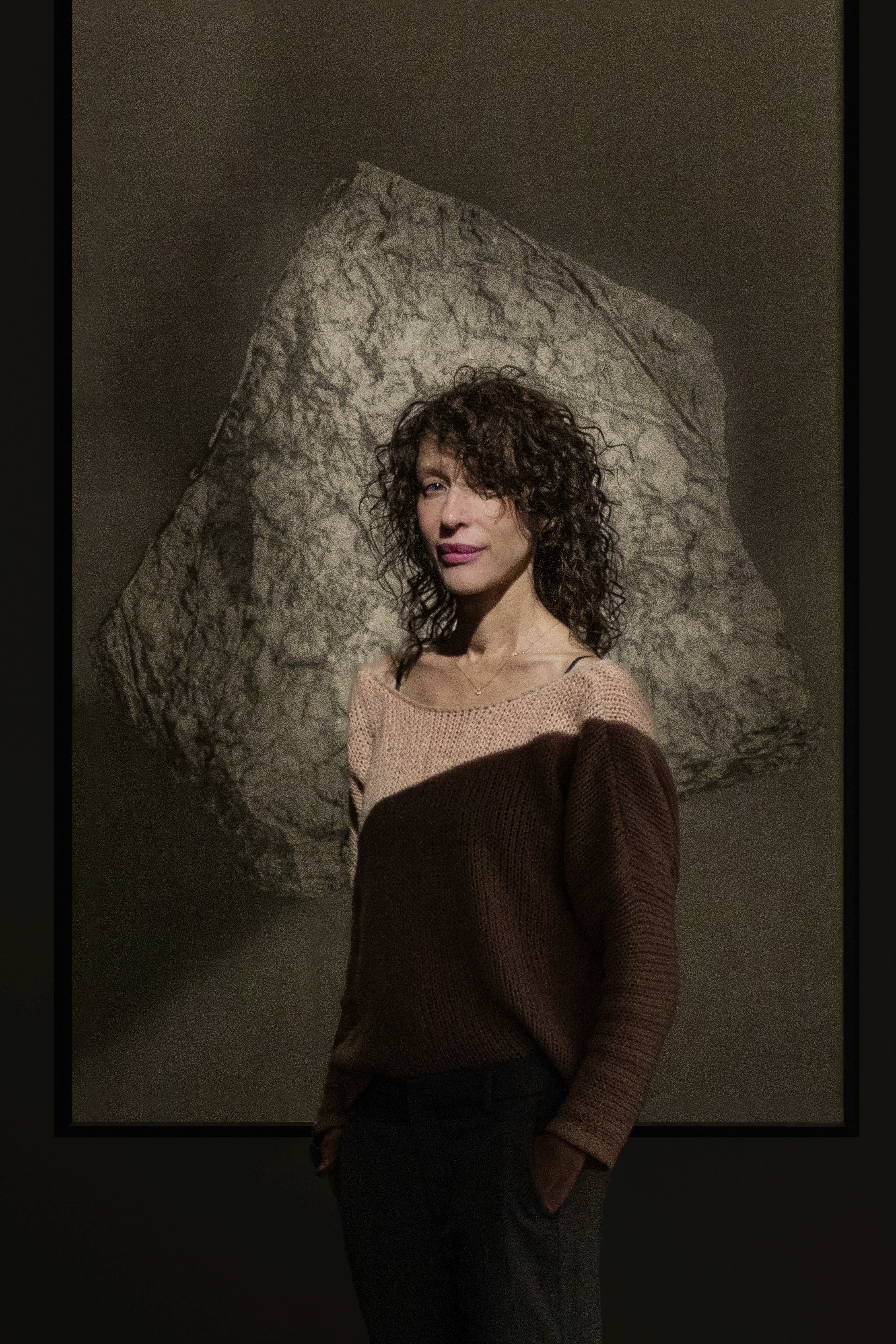
BIOGRAPHIE
Amélie Labourdette, née en 1974 à Troyes, est artiste visuelle et photographe. Elle vit et travaille à Paris. Diplômée de l’École des Beaux-Arts Nantes Saint-Nazaire, elle explore dans ses œuvres des temporalités stratifiées et convoque les spectres d’entités naturelles non humaines encloses dans la matérialité des phénomènes, tout en honorant, dans une perspective animiste, leur agentivité et leur subjectivité. Ses préoccupations écosophiques s’incarnent dans une interrogation profonde de la matérialité du médium photographique.
Son œuvre a été présentée dans le cadre d’expositions personnelles et collectives en France et à l’international, notamment en Chine, en Suisse, au Royaume-Uni, en Tunisie et en Italie. Parmi ses expositions marquantes figurent NEO-ANALOG – Expanded Photography in the Post-Digital Era, sous le commissariat de Michel Poivert, présentée dans le cadre de la 8e Triennale de l’image de Guangzhou – Ecology of Sensitivity, Guangdong Museum of Art (2025–2026), unRepresented by a ppr oc he, Paris (2024), Lire les lignes du monde, PhotoSaintGermain, sous le commissariat de Pascal Beausse et Aurélia Marcadier, Galerie du Crous, Paris (2023), KÓSMOS, Galerie Artothèque Pierre Tal-Coat, dans le cadre des Rencontres Photographiques de Lorient (2023), Un pur esprit s’accroît sous l’écorce des pierres, Galerie Michel Journiac, Paris (2022), Cet autre monde qui est aussi le nôtre, Open School Gallery, Nantes (2019), Traces d’une occupation humaine, Galerie Le Carré d’Art, Chartres-de-Bretagne (2018), et Empire of Dust, Galerie Bigaignon, Paris (2017).
Lauréate de plusieurs distinctions, elle reçoit en 2016 le Sony World Photography Awards, dans la catégorie Architecture, puis en 2017 la Bourse de soutien à la photographie documentaire contemporaine du Centre national des arts plastiques – CNAP. En 2020, elle est finaliste du Prix Découverte Prix Découverte de la Fondation Louis Roederer, dans le cadre des Rencontres d’Arles. En 2026, elle figure parmi les finalistes de la 15e édition du concours Talents Contemporains de la Fondation François Schneider, dont les lauréats seront annoncés entre fin mai et début juin 2026.
Ses œuvres figurent dans plusieurs collections publiques et privées. En 2021, cinq tirages de la série KÓSMOS intègrent la Collection photographique du Centre national des arts plastiques – CNAP.
Depuis 2015, elle a été invitée en résidence dans différents contextes internationaux, notamment à Agire Residenza Arte, Sicile, dans le gouvernorat de Gafsa, Tunisie, au programme Fieldwork Marfa, Texas, ainsi qu’au New York State Museum, Albany, États-Unis. Ces résidences ont accompagné et nourri le développement de ses projets de recherche et de création.
DÉMARCHE ARTISTIQUE
L’œuvre d’Amélie Labourdette, principalement liée au médium photographique, se déploie à travers la mobilisation de récits mineurs et la révision des récits historiques dominants. Ces récits mineurs remettent en question les formes hégémoniques de savoir et de représentation du monde, et interrogent l’histoire postcoloniale et l’écologie à l’ère du capitalisme.
Sa pratique s’inscrit dans une exploration du temps, de la matière et de la spectralité, dans une quête de ce qui subsiste sous la surface visible du monde. Elle poursuit cette idée d’une image hantée par son propre sujet et conservant, dans sa matérialité même, une survivance dans un sens proche du Nachleben warburgien, c’est-à-dire la persistance spectrale de formes issues d’autres temporalités, qui réapparaissent dans le présent sous des formes transmuées. C’est cette qualité spectrale qui lui confère sa puissance singulière, celle d’offrir au regard une profondeur temporelle par-delà l’immédiateté du visible.
Amélie Labourdette envisage la chair du paysage comme archive, un livre-Terre à décrypter. À travers une lecture perspectiviste du territoire et la saisie de traces, chaque projet aborde les relations complexes entre l’humain, la biosphère terrestre et le cosmos. Elle sonde, à travers le médium photographique, l’étrangeté primordiale de notre kósmos, perçu comme un monde crypté, afin d’en saisir le maillage et les interrelations entre les entités humaines et les entités naturelles non-humaines. C’est précisément cet enchevêtrement qu’elle questionne, appelant à une réimagination de récits susceptible de déconstruire la fiction d’une position humaine centrale.
Ces réalisations participent d’un pluralisme ontologique¹ en observant différents modes d’existence et en reconnaissant une forme de sensibilité et de subjectivité aux entités non-humaines. Reconnaître un esprit agissant dans chaque strate de la nature – animale, végétale, minérale – relativise toute supériorité ontologique de l’humanité. L’artiste devient une figure liminale, un intercesseur entre les mondes des entités naturelles et des humains, déjouant les séparations habituellement établies entre humains et non-humains, visible et invisible, science et art.
Les recherches d’Amélie Labourdette combinent les sciences de la vie, la paléobotanique, l’analyse anthropologique et archéologique, les cosmovisions autochtones et une poésie subjective des images. Elle met au jour les intrications du monde en s’inspirant de la méthodologie warburgienne. Par associations analogiques et intuitives, elle relie diverses connaissances et perceptions, dépassant les cloisonnements disciplinaires. Ses créations plastiques révèlent des interconnexions de sens et de formes. Chaque projet est avant tout une enquête, invitant à des nouages d’espaces-temps où les catégories du passé, du présent et du futur s’entremêlent.
Ces œuvres proposent de nous reconnecter de manière sensible à l’esprit des lieux, aux spectres animaux et végétaux, enclos dans la matérialité des phénomènes, et suggèrent une alternative à une vision présentiste² de l’histoire en nous reliant à une histoire humaine et plus qu’humaine sur le temps long. Matérialiser la vibration de ces mémoires est consubstantiel à l’expérience de la chair du monde³ : une expérience reliant corps et esprit, sensibilité aux fréquences vibratoires des lieux et vision intérieure, ouverte au tangible et à l’intangible.
Selon l’historien de la photographie et commissaire d’exposition Michel Poivert, « Ces questions écosophiques, et leurs traductions plastiques, prennent la forme d’une profonde interrogation du médium photographique à travers l’exploration et l’expérimentation de sa matérialité. »
¹ Dans une optique biocentrique, le “pluralisme ontologique“ se réfère à l’approche reconnaissant la multiplicité des formes de vie et des perspectives, accordant une valeur égale aux différentes entités non-humaines et humaines dans l’univers.
² Le “présentisme“ selon François Hartog est un “régime d’historicité“ qui place le présent comme principal point de référence pour comprendre le passé et envisager le futur, reléguant ainsi une perspective à long terme de l’histoire au second plan.
³ Le Visible et l’invisible / Maurice Merleau-Ponty, publié par Cl. Lefort, Gallimard, 1964.
BIOGRAPHY
Amélie Labourdette, born in 1974 in Troyes, is a visual artist and photographer. She lives and works in Paris. A graduate of the École des Beaux-Arts Nantes Saint-Nazaire, her works explore stratified temporalities and summon the spectres of non-human natural entities enclosed within the materiality of phenomena, while honouring, from an animist perspective, their agency and subjectivity. Her ecosophical concerns take shape through a profound interrogation of the materiality of the photographic medium.
Her work has been presented in solo and group exhibitions in France and internationally, notably in China, Switzerland, the United Kingdom, Tunisia, and Italy. Selected exhibitions include NEO-ANALOG – Expanded Photography in the Post-Digital Era, curated by Michel Poivert, presented as part of the 8th Guangzhou Image Triennial – Ecology of Sensitivity, Guangdong Museum of Art (2025–2026), unRepresented by a ppr oc he, Paris (2024), Lire les lignes du monde, PhotoSaintGermain, curated by Pascal Beausse and Aurélia Marcadier, Galerie du Crous, Paris (2023), KÓSMOS, Galerie Artothèque Pierre Tal-Coat, as part of the Rencontres Photographiques de Lorient (2023), A Pure Spirit Grows Beneath the Bark of Stones, Galerie Michel Journiac, Paris (2022), Cet autre monde qui est aussi le nôtre, Open School Gallery, Nantes (2019), Traces of a Human Occupation, Galerie Le Carré d’Art, Chartres-de-Bretagne (2018), and Empire of Dust, Galerie Bigaignon, Paris (2017).
The recipient of several distinctions, she received the Sony World Photography Awards in 2016, in the Architecture category, followed in 2017 by the Contemporary Documentary Photography Support Grant from the Centre national des arts plastiques – CNAP. In 2020, she was a finalist for the Louis Roederer Foundation Discovery Award, as part of the Rencontres d’Arles. In 2026, she is among the finalists of the 15th edition of the Talents Contemporains competition of the Fondation François Schneider, whose prizewinners will be announced between late May and early June 2026.
Her works are held in several public and private collections. In 2021, five prints from the KÓSMOS series entered the Photographic Collection of the Centre national des arts plastiques – CNAP.
Since 2015, she has been invited to undertake residencies in various international contexts, notably at Agire Residenza Arte, Sicily, in the Governorate of Gafsa, Tunisia, at the Fieldwork Marfa programme, Texas, as well as at the New York State Museum, Albany, United States. These residencies have accompanied and nourished the development of her research and creative projects.
ARTISTIC APPROACH
The work of Amélie Labourdette, primarily linked to the photographic medium, unfolds through the mobilization of minor narratives and the revision of dominant historical narratives. These minor narratives call into question hegemonic forms of knowledge and representation of the world, and interrogate postcolonial history and ecology in the age of capitalism.
Her practice is situated within an exploration of time, matter, and spectrality, in a quest for what subsists beneath the visible surface of the world. She pursues this idea of an image haunted by its own subject and preserving, in its very materiality, a survival in a sense close to Warburgian Nachleben, that is, the spectral persistence of forms originating from other temporalities, which reappear in the present in transmuted forms. It is this spectral quality that confers upon it its singular power: that of offering the gaze a temporal depth beyond the immediacy of the visible.
Amélie Labourdette envisages the flesh of the landscape as archive, an Earth-book to be deciphered. Through a perspectivist reading of territory and the capture of traces, each project addresses the complex relations between the human, the terrestrial biosphere, and the cosmos. Through the photographic medium, she probes the primordial strangeness of our kósmos, perceived as an encrypted world, in order to grasp its meshwork and the interrelations between human entities and non-human natural entities. It is precisely this entanglement that she questions, calling for a reimagining of narratives capable of deconstructing the fiction of a central human position.
These works participate in an ontological pluralism¹ by observing different modes of existence and by recognizing a form of sensitivity and subjectivity in non-human entities. To recognize an acting spirit in each stratum of nature—animal, vegetal, mineral—is to relativize any ontological superiority of humanity. The artist becomes a liminal figure, an intercessor between the worlds of natural entities and humans, undoing the separations habitually established between humans and non-humans, visible and invisible, science and art.
Amélie Labourdette’s research combines the life sciences, paleobotany, anthropological and archaeological analysis, Indigenous cosmovisions, and a subjective poetics of images. She brings to light the intrications of the world by drawing on Warburgian methodology. Through analogical and intuitive associations, she connects diverse forms of knowledge and perception, moving beyond disciplinary compartmentalizations. Her visual works reveal interconnections of meaning and form. Each project is above all an inquiry, inviting knottings of space-times in which the categories of past, present, and future intermingle.
These works propose that we reconnect, in a sensitive manner, to the spirit of places, to animal and vegetal spectres enclosed within the materiality of phenomena, and suggest an alternative to a presentist² vision of history by linking us to a human and more-than-human history over the long term. To materialize the vibration of these memories is consubstantial with the experience of the flesh of the world³: an experience connecting body and mind, sensitivity to the vibratory frequencies of places and inner vision, open to the tangible and the intangible.
According to photography historian and exhibition curator Michel Poivert, “These ecosophical questions, and their plastic translations, take the form of a profound interrogation of the photographic medium through the exploration and experimentation of its materiality.”
¹ From a biocentric perspective, “ontological pluralism” refers to an approach that recognizes the multiplicity of forms of life and perspectives, granting equal value to different non-human and human entities in the universe.
² “Presentism,” according to François Hartog, is a “regime of historicity” that places the present as the principal point of reference for understanding the past and envisaging the future, thereby relegating a long-term perspective of history to the background.
³ The Visible and the Invisible / Maurice Merleau-Ponty, published by Cl. Lefort, Gallimard, 1964.